INDICATION
ENHERTU is a HER2-directed antibody and
topoisomerase inhibitor
conjugate indicated for:
- HER2-Positive
Metastatic Breast Cancer
- In combination with pertuzumab as first-line treatment of adult patients with
unresectable or metastatic HER2-positive (IHC 3+ or ISH+) breast cancer, as
determined by an FDA-authorized test
- As monotherapy for the treatment of adult patients with unresectable or metastatic
HER2-positive (IHC 3+ or ISH+) breast cancer who have received a prior
anti-HER2-based regimen either in the metastatic setting, or, in the neoadjuvant or
adjuvant setting and have developed disease recurrence during or within six months
of completing therapy
Contraindications
None.
Warnings and
Precautions
Interstitial
Lung Disease / Pneumonitis
Severe, life-threatening, or fatal interstitial lung disease (ILD), including pneumonitis, can occur
in patients treated with ENHERTU. A higher incidence of Grade 1 and 2
ILD/pneumonitis has been observed in patients with moderate renal impairment. Advise patients to
immediately report cough, dyspnea, fever, and/or any new or worsening respiratory symptoms. Monitor
patients for signs and symptoms of ILD. Promptly investigate evidence of ILD. Evaluate patients with
suspected ILD by radiographic imaging. Consider consultation with a pulmonologist. For asymptomatic
ILD/pneumonitis (Grade 1), interrupt ENHERTU until resolved to Grade 0, then if resolved in ≤28 days
from date of onset, maintain dose. If resolved in >28 days from date of onset, reduce dose 1 level.
Consider corticosteroid treatment as soon as ILD/pneumonitis is suspected (e.g., ≥0.5 mg/kg/day
prednisolone or equivalent). For symptomatic ILD/pneumonitis (Grade 2 or greater), permanently
discontinue ENHERTU. Promptly initiate systemic corticosteroid treatment as soon as ILD/pneumonitis
is suspected (e.g., ≥1 mg/kg/day prednisolone or equivalent) and continue for at least 14 days
followed by gradual taper for at least 4 weeks.
Metastatic Breast Cancer and Other Solid Tumors (5.4 mg/kg)
ENHERTU as Monotherapy
In patients treated with ENHERTU 5.4 mg/kg, ILD occurred in 12% of patients. Median time to first
onset was 5.5 months (range: 0.9 to 31.5). Fatal outcomes due to ILD and/or pneumonitis occurred in
0.9% of patients treated with ENHERTU.
ENHERTU in Combination with Pertuzumab
In patients treated with ENHERTU 5.4 mg/kg in
combination with pertuzumab (N=431), ILD
occurred in 12% of patients. Median time to
first onset was 8.0 months (range: 0.6 to 33.8).
Fatal outcomes due to ILD and/or pneumonitis
occurred in 0.5% of patients treated with
ENHERTU in combination with pertuzumab.
Neutropenia
Severe neutropenia, including febrile neutropenia, can occur in patients treated with ENHERTU. Monitor
complete blood counts prior to initiation of ENHERTU and prior to each dose, and as clinically
indicated. For Grade 3 neutropenia (Absolute Neutrophil Count [ANC] <1.0 to 0.5 x 10
9/L),
interrupt ENHERTU until resolved to Grade 2 or less, then maintain dose. For Grade 4 neutropenia (ANC
<0.5 x 10
9/L), interrupt ENHERTU until resolved to Grade 2 or less, then reduce dose by 1
level. For febrile neutropenia (ANC <1.0 x 10
9/L and temperature >38.3º C or a
sustained temperature of ≥38º C for more than 1 hour), interrupt ENHERTU until resolved, then reduce
dose by 1 level.
Metastatic Breast Cancer and Other Solid Tumors (5.4 mg/kg)
ENHERTU as Monotherapy
In patients treated with ENHERTU 5.4 mg/kg, a decrease in neutrophil count was reported in 65% of
patients. Nineteen percent had Grade 3 or 4 decreased neutrophil count. Median time to first onset
of decreased neutrophil count was 22 days (range: 2 to 939). Febrile neutropenia was reported in 1%
of patients.
ENHERTU in Combination with Pertuzumab
In patients treated with ENHERTU
5.4 mg/kg in combination with pertuzumab
(N=431), decreased neutrophil count occurred in
79% of patients. Median time to first onset was
22 days (range: 5 to 994). Twenty-nine percent
had Grade 3 or 4 decreased neutrophil count.
Febrile neutropenia was reported in 2.6% of
patients.
Left Ventricular
Dysfunction
Patients treated with ENHERTU may be at increased risk of developing
left ventricular dysfunction. Left ventricular dysfunction (LVD)
has been observed with anti-HER2 therapies, including ENHERTU.
Assess left ventricular ejection fraction (LVEF) prior to initiation of ENHERTU and at regular intervals
during treatment as clinically indicated. Manage LVD through
treatment interruption. When LVEF is >45% and absolute decrease from
baseline is 10-20%, continue treatment with ENHERTU. When LVEF is 40-45%
and absolute decrease from baseline is
<10%, continue treatment with
ENHERTU and repeat LVEF assessment within 3 weeks. When LVEF is
40-45% and absolute decrease from baseline is 10-20%, interrupt
ENHERTU and repeat LVEF assessment within 3 weeks. If LVEF has not
recovered to within 10% from baseline, permanently discontinue
ENHERTU. If LVEF recovers to within 10% from baseline, resume
treatment with ENHERTU at the same dose. When LVEF is
<40% or
absolute decrease from baseline is >20%, interrupt ENHERTU and repeat
LVEF assessment within 3 weeks. If LVEF of
<40% or absolute decrease
from baseline of >20% is confirmed, permanently discontinue
ENHERTU. Permanently discontinue ENHERTU in patients with
symptomatic congestive heart failure. Treatment with ENHERTU has
not been studied in patients with a history of clinically
significant cardiac disease or LVEF
<50% prior to initiation of
treatment.
Metastatic Breast Cancer and Other Solid Tumors (5.4 mg/kg)
ENHERTU as Monotherapy
In patients treated with ENHERTU 5.4 mg/kg, LVD was reported in 4.6% of patients, of which 0.6% were
Grade 3 or 4.
ENHERTU in Combination with Pertuzumab
In patients treated with ENHERTU
5.4 mg/kg in combination with pertuzumab
(N=431), LVEF decrease was reported in 11% of
patients, of which 2.1% were Grade 3 or 4.
Embryo-Fetal
Toxicity
ENHERTU can cause fetal harm when administered to a pregnant woman. Advise patients of the potential
risks to a fetus. Verify the pregnancy status of females of reproductive potential prior to the
initiation of ENHERTU. Advise females of reproductive potential to use effective contraception
during treatment and for 7 months after the last dose of ENHERTU. Advise male patients with female
partners of reproductive potential to use effective contraception during treatment with ENHERTU and
for 4 months after the last dose of ENHERTU.
Additional Dose
Modifications
Thrombocytopenia
For Grade 3 thrombocytopenia (platelets <50 to 25 x 109/L)
interrupt ENHERTU until resolved to Grade 1 or less, then maintain dose. For Grade 4
thrombocytopenia (platelets <25 x 109/L) interrupt ENHERTU until resolved to Grade 1
or less, then reduce dose by 1 level.
Adverse
Reactions
Metastatic Breast Cancer and Other Solid Tumors (5.4 mg/kg)
ENHERTU as
Monotherapy
The pooled safety population reflects exposure to ENHERTU 5.4 mg/kg intravenously every 3 weeks in
2233 patients in Study DS8201-A-J101 (NCT02564900), DESTINY-Breast01, DESTINY-Breast02,
DESTINY-Breast03, DESTINY-Breast04, DESTINY-Breast06, and other clinical trials. Among these
patients, 67% were exposed for >6 months and 39% were exposed for >1 year. In this pooled safety
population, the most common (≥20%) adverse reactions, including laboratory abnormalities, were
decreased white blood cell count (73%), nausea (72%), decreased hemoglobin (67%), decreased
neutrophil count (65%), decreased lymphocyte count (60%), fatigue (55%), decreased platelet count
(48%), increased aspartate aminotransferase (46%), increased alanine aminotransferase (43%),
increased blood alkaline phosphatase (39%), vomiting (38%), alopecia (37%), constipation (32%),
decreased blood potassium (32%), decreased appetite (31%), diarrhea (30%), and musculoskeletal pain
(24%).
ENHERTU in Combination
with Pertuzumab
The pooled safety population
reflects exposure to ENHERTU 5.4 mg/kg in
combination with pertuzumab intravenously every
3 weeks in 431 patients in DESTINY-Breast07
(n=50), and DESTINY-Breast09 (n=381). Among
these patients, 86% were exposed for >6
months and 73% were exposed for >1 year. In
this pooled safety population, the most common
(≥20%) adverse reactions, including laboratory
abnormalities, were decreased white blood cell
count (86%), decreased hemoglobin (80%),
decreased neutrophil count (79%), nausea (74%),
increased alanine aminotransferase (65%),
diarrhea (64%), increased aspartate
aminotransferase (63%), decreased lymphocyte
count (61%), decreased platelet count (55%),
increased blood alkaline phosphatase (54%),
decreased blood potassium (54%), fatigue (53%),
alopecia (48%), vomiting (46%), upper
respiratory tract infection (32%), constipation
(31%), decreased appetite (31%), decreased
weight (28%), musculoskeletal pain (23%),
increased blood bilirubin (23%), and abdominal pain (22%).
HER2-Positive Metastatic Breast Cancer
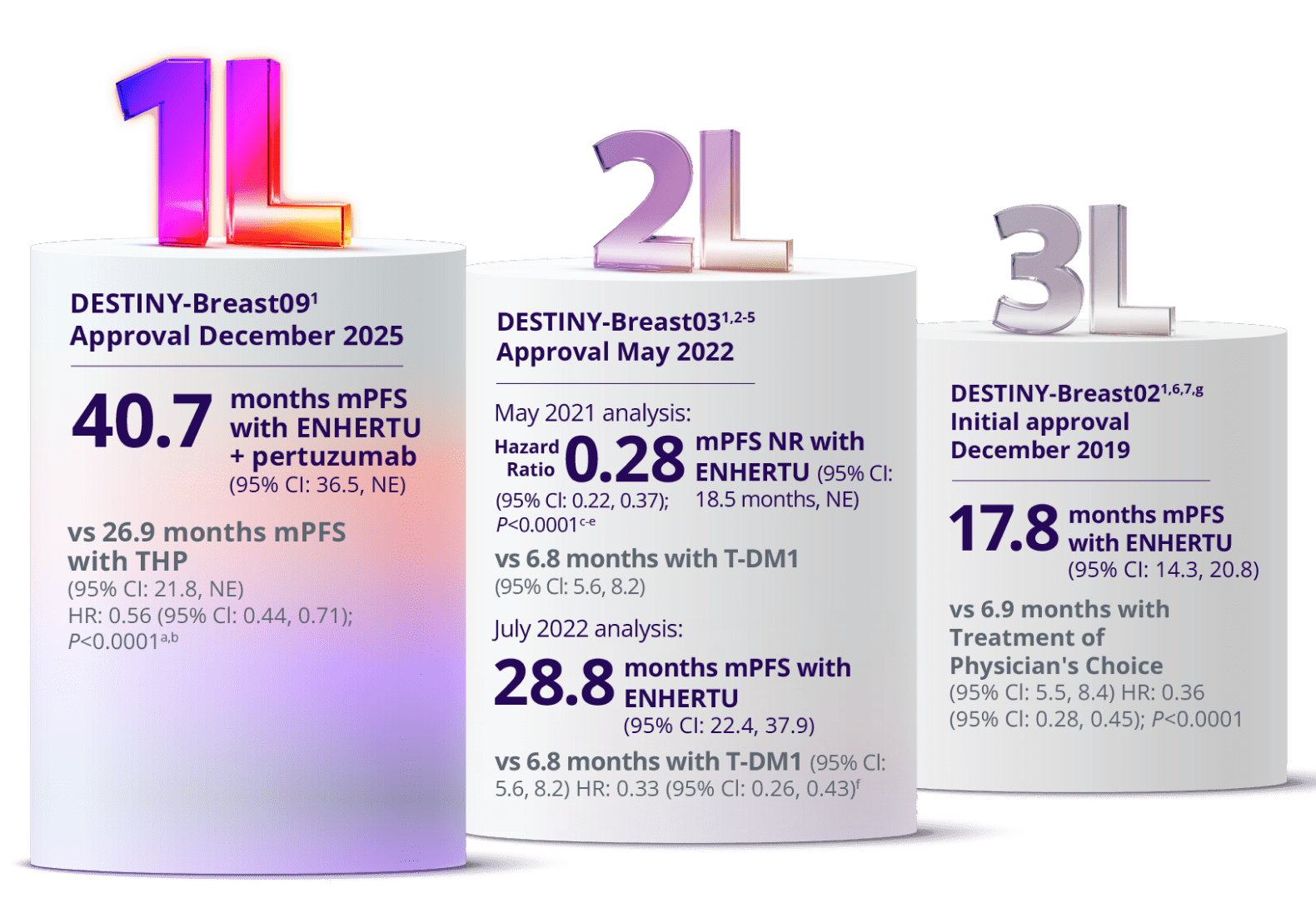
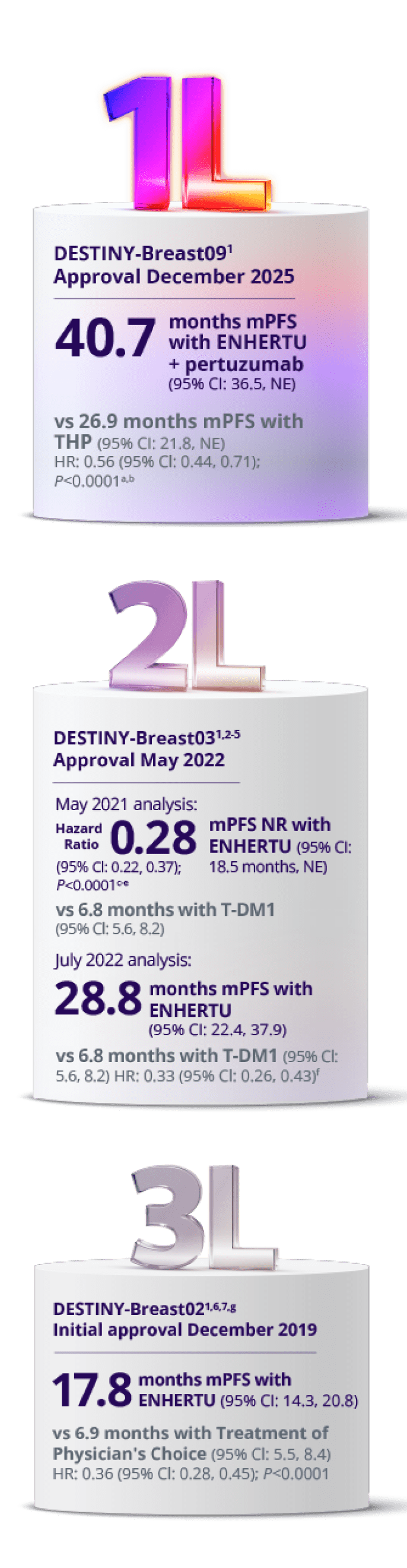
DESTINY-Breast09
The safety of ENHERTU 5.4 mg/kg in combination with pertuzumab was evaluated in
DESTINY-Breast09, a randomized, three-arm, multicenter study including 763 patients with
HER2-positive (IHC 3+ or ISH+) unresectable or metastatic breast cancer. Three hundred eighty-one
patients received ENHERTU in combination with pertuzumab and 382 patients received THP (taxane
[docetaxel or paclitaxel], trastuzumab, and pertuzumab). Among patients who received ENHERTU in
combination with pertuzumab, the median duration of treatment was 22 months (range: 0.3 months to
44.5 months).
Serious adverse reactions occurred in 27% of patients receiving ENHERTU in
combination with pertuzumab. Serious adverse reactions in >1% of patients were diarrhea, pneumonia,
febrile neutropenia, hypokalemia, vomiting, ILD, pulmonary embolism, and sepsis. Fatalities due to
adverse reactions occurred in 3.4% of patients including pneumonia (n=3), ILD (n=2), sepsis (n=2),
pulmonary embolism, septic shock, acute kidney injury, dyspnea, febrile neutropenia, and intestinal
ischemia (1 patient each).
ENHERTU was discontinued for
adverse reactions in 21% of patients. The most
frequent adverse reaction (>2%) associated
with permanent discontinuation was
ILD/pneumonitis (6%). Dose interruptions due
to adverse reactions occurred in 69% of
patients. The most frequent adverse reactions
(>2%) associated with dose interruption were
COVID-19, neutropenia, upper respiratory tract
infection, fatigue, anemia, hypokalemia,
ILD/pneumonitis, thrombocytopenia, pneumonia,
diarrhea, transaminase increased, leukopenia,
cough, pyrexia, decreased appetite, and blood
bilirubin increased. Dose reductions occurred in
46% of patients treated with ENHERTU in
combination with pertuzumab. The most frequent
adverse reactions (>2%) associated with dose
reduction were fatigue, neutropenia, nausea,
diarrhea, ILD/pneumonitis, thrombocytopenia,
vomiting, transaminases increased, decreased
weight, febrile neutropenia, and hypokalemia.
The most common (≥20%) adverse
reactions, including laboratory abnormalities,
were decreased white blood cell count (87%),
decreased hemoglobin (80%), decreased neutrophil
count (78%), nausea (75%), increased alanine
aminotransferase (66%), diarrhea (64%),
increased aspartate aminotransferase (62%),
decreased lymphocyte count (62%), decreased
platelet count (56%), increased blood alkaline
phosphatase (55%), decreased blood potassium
(54%), fatigue (53%), alopecia (48%), vomiting
(46%), upper respiratory tract infection (33%),
constipation (33%), decreased appetite (32%),
decreased weight (30%), COVID-19 (28%),
musculoskeletal pain (24%), increased blood
bilirubin (23%), and abdominal pain (23%).
DESTINY-Breast03
The safety of ENHERTU was evaluated in 257 patients with unresectable or metastatic HER2-positive
breast cancer who received at least 1 dose of ENHERTU 5.4 mg/kg intravenously once every 3 weeks in
DESTINY-Breast03. The median duration of treatment was 14 months (range: 0.7 to 30) for patients who
received ENHERTU.
Serious adverse reactions occurred in 19% of patients receiving ENHERTU. Serious adverse reactions
in >1% of patients who received ENHERTU were vomiting, ILD, pneumonia, pyrexia, and urinary tract
infection. Fatalities due to adverse reactions occurred in 0.8% of patients including COVID-19 and
sudden death (1 patient each).
ENHERTU was permanently discontinued in 14% of patients, of which ILD/pneumonitis accounted for 8%.
Dose interruptions due to adverse reactions occurred in 44% of patients treated with ENHERTU. The
most frequent adverse reactions (>2%) associated with dose interruption were neutropenia,
leukopenia, anemia, thrombocytopenia, pneumonia, nausea, fatigue, and ILD/pneumonitis. Dose
reductions occurred in 21% of patients treated with ENHERTU. The most frequent adverse reactions
(>2%) associated with dose reduction were nausea, neutropenia, and fatigue.
The most common (≥20%) adverse reactions, including laboratory abnormalities, were nausea (76%),
decreased white blood cell count (74%), decreased neutrophil count (70%), increased aspartate
aminotransferase (67%), decreased hemoglobin (64%), decreased lymphocyte count (55%), increased
alanine aminotransferase (53%), decreased platelet count (52%), fatigue (49%), vomiting (49%),
increased blood alkaline phosphatase (49%), alopecia (37%), decreased blood potassium (35%),
constipation (34%), musculoskeletal pain (31%), diarrhea (29%), decreased appetite (29%), headache
(22%), respiratory infection (22%), abdominal pain (21%), increased blood bilirubin (20%), and
stomatitis (20%).
Use in Specific
Populations
- Pregnancy: ENHERTU can cause fetal harm when administered
to a pregnant woman. Advise patients of the potential risks to a fetus. There are clinical
considerations if ENHERTU is used in pregnant women, or if a patient becomes pregnant within 7
months after the last dose of ENHERTU.
- Lactation: There are no data regarding the presence of
ENHERTU in human milk, the effects on the breastfed child, or the effects on milk production.
Because of the potential for serious adverse reactions in a breastfed child, advise women not to
breastfeed during treatment with ENHERTU and for 7 months after the last dose.
- Females and Males of Reproductive
Potential: Pregnancy
testing: Verify pregnancy status of females of
reproductive potential prior to initiation of ENHERTU. Contraception:
Females: ENHERTU can cause fetal harm when administered to
a pregnant woman. Advise females of reproductive potential to use
effective contraception during treatment with ENHERTU and for 7
months after the last dose. Males: Advise male patients
with female partners of reproductive potential to use effective
contraception during treatment with ENHERTU and for 4 months after
the last dose. Infertility: ENHERTU
may impair male reproductive function and fertility.
- Pediatric Use: Safety and effectiveness of ENHERTU have
not been established in pediatric patients.
-
Geriatric Use: ENHERTU as Monotherapy: Of the
2233 patients treated with ENHERTU 5.4 mg/kg, 28% were ≥65 years and 6% were ≥75 years. No
overall differences in efficacy within clinical studies were observed between patients ≥65 years
compared to younger patients. There was a higher incidence of Grade 3-4 adverse reactions
observed in patients aged ≥65 years (56%) as compared to younger patients (49%).
ENHERTU in Combination with Pertuzumab: In patients with HER2-positive unresectable or
metastatic breast cancer treated with ENHERTU 5.4 mg/kg in combination with pertuzumab (N=431),
17% were ≥65 years and 3% were ≥75 years. No overall differences in efficacy or safety were
observed between patients ≥65 years compared to younger patients.
- Renal Impairment: A higher incidence of Grade 1 and 2
ILD/pneumonitis has been observed in patients with moderate renal impairment. Monitor patients
with moderate renal impairment more frequently. The recommended dosage of ENHERTU has not been
established for patients with severe renal impairment (CLcr <30 mL/min).
- Hepatic Impairment: In patients with moderate hepatic
impairment, due to potentially increased exposure, monitor for increased adverse reactions
related to the topoisomerase inhibitor, DXd. The recommended dosage of ENHERTU has not been
established for patients with severe hepatic impairment (total bilirubin >3 times ULN and any
AST).
To report SUSPECTED ADVERSE
REACTIONS, contact Daiichi Sankyo, Inc. at
1-877-437-7763 or FDA at
1-800-FDA-1088 or
fda.gov/medwatch.
Please click here for
full Prescribing Information,
including Boxed WARNINGS, and click here for Medication
Guide.